Earlier this week, I shared a post about the stories we tell ourselves and how they shape the organisations we create.
It sparked some really interesting conversations. And quite a few people challenged the idea.
Does changing the story actually change anything? Aren’t our beliefs shaped by the systems we operate in? And what happens when leaders start telling a new story, but people’s everyday experiences remain exactly the same?
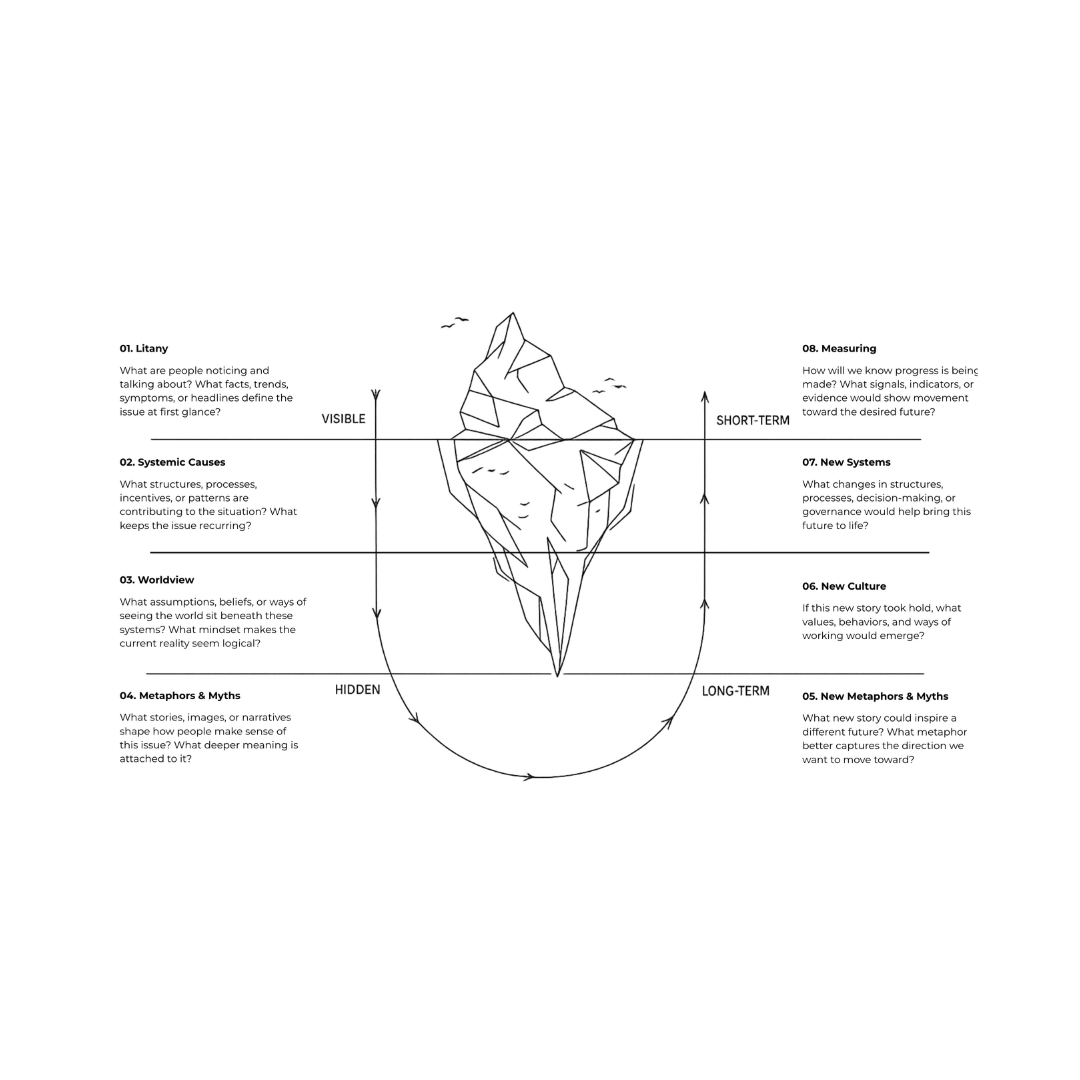
All good questions. And they’ve made me reflect further on what I find so valuable about Causal Layered Analysis, the framework behind my original post.
Because the point of the framework isn’t that changing the story is enough.
Quite the opposite.
It invites us to look at multiple layers of reality. From the visible problems and symptoms, through the systems and structures that produce them, to the assumptions, worldviews and deeper narratives that make those systems seem logical.
And then to work our way back up again. Not just imagining new stories, but exploring what different cultures, behaviours, structures and systems might look like.
We move down to understand why the current reality exists. And back up to explore how we might create a different one.
A few reflections I’ve taken from the conversations:
1. It’s not either stories or systems. It’s both.
Our beliefs shape the systems we create. But the systems we operate in also shape what we come to believe.
If leaders are consistently rewarded for having all the answers, that reinforces the belief that good leaders should always know best.
And that belief, in turn, influences how we design leadership roles, make decisions and distribute responsibility.
It’s a reinforcing loop. And changing one part of it can influence the others.
2. Deeper doesn’t necessarily mean more important.
One potential trap with the iceberg metaphor is assuming that the deeper layers are somehow more fundamental than the visible ones.
But sometimes our beliefs are simply rational responses to the systems we’re part of.
If speaking up gets you punished, believing that silence is safer isn’t necessarily a limiting mindset. It’s a reasonable conclusion.
In that case, changing the story about psychological safety without changing the actual consequences of speaking up won’t get us very far.
Sometimes we need to change the system to make a different story possible.
3. The story isn’t owned by leadership.
One of the most interesting comments was about the difference between the culture leaders believe they’ve created and the culture people actually experience.
And I think this is critical.
Organisational narratives aren’t simply communicated from the top. They’re continuously created and reinforced through relationships, expectations, decisions and everyday experiences.
That’s why this work needs to involve people from across the organisation. Not just to build buy-in, but to understand the different realities people are living in.
So where does this leave us?
I don’t think every organisational challenge requires us to dig into deeply held narratives. Sometimes a broken process is just a broken process.
But when the same challenges keep reappearing, despite our best efforts to solve them, perhaps we need to become more curious about what’s sustaining them.
Not just asking what needs to change, but why things are the way they are in the first place.
And then working across the different layers, rather than assuming that one intervention will solve everything.
Because ultimately, transformation isn’t about replacing an old story with a better one. It’s about creating greater alignment between what we believe, how we behave and how our organisations actually work.

WANT TO GET NOTIFIED ABOUT OUR EVENTS?
Join our mailing list for tips, events, and opportunities.