Understanding the deeper systems, assumptions and stories that shape change.
When organisations face complex challenges, the instinct is often to focus on what is most visible: declining performance, resistance to change or emerging market pressures. But what if these are symptoms of something deeper?
Causal Layered Analysis (CLA) is a framework for exploring complex problems beyond their surface-level symptoms. It helps individuals and organisations examine not only what is happening, but why it is happening, which assumptions sustain it and what alternative futures might be possible.
What is Causal Layered Analysis?
Causal Layered Analysis is a futures thinking and strategic analysis method developed by futurist Sohail Inayatullah and formally introduced in 1998. Rather than attempting to predict the future, CLA helps us challenge existing ways of thinking and explore different possibilities for change.
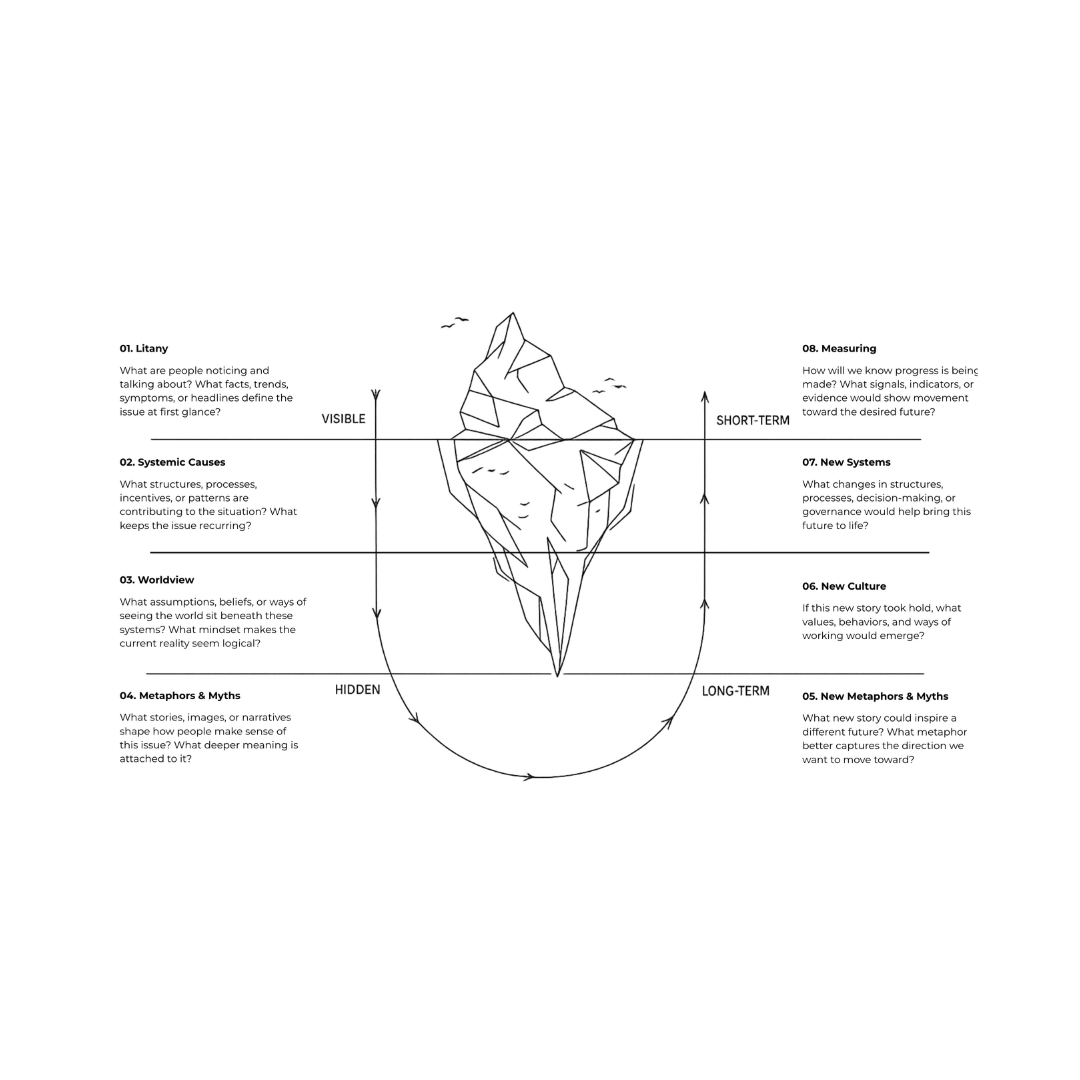
The framework examines an issue through four interconnected layers, moving from visible problems to the deeper beliefs and narratives that influence how we understand them.
The four layers of Causal Layered Analysis
1. Litany: What is happening?
The first layer focuses on what we can observe: facts, headlines, trends and commonly discussed problems. For example, an organisation might notice that employees are resisting a new way of working. At this level, the conversation often focuses on immediate symptoms and short-term solutions.
2. Systems: What is causing it?
The second layer explores the structures and conditions behind the visible problem. These might include organisational processes, incentives, leadership practices, technologies or policies. In our example, resistance to change might be connected to conflicting priorities, limited resources or systems that reward existing behaviours.
3. Worldview: What assumptions sustain the system?
The third layer examines the beliefs, values and perspectives that shape how people understand the situation. Perhaps leaders believe that change must be driven from the top, while employees have learned that challenging established practices carries risks. These assumptions influence which solutions seem reasonable, realistic or even possible.
4. Myth and metaphor: What deeper stories shape our thinking?
The fourth layer explores the underlying stories, images and metaphors that give meaning to our experiences. An organisation might describe itself as a well-oiled machine, where efficiency and control are valued above experimentation. What would change if it instead viewed itself as a learning ecosystem, where adaptation, collaboration and continuous development are essential? Changing the metaphor can open up entirely different ways of imagining the future.
How is Causal Layered Analysis used?
CLA can be applied in strategic planning, organisational transformation, leadership development, innovation and futures thinking. Typically, individuals or groups begin with a challenge and explore it through each of the four layers. They then consider alternative assumptions, narratives and ways of organising that could create different outcomes. The process is not necessarily linear. Moving back and forth between layers helps reveal connections that might otherwise remain invisible.
Why is Causal Layered Analysis valuable for leaders?
Complex challenges rarely have simple causes. By looking beyond immediate problems, leaders can develop a more nuanced understanding of the systems they operate within.
CLA encourages several important capabilities:
- Systems thinking: Understanding how structures, behaviours and beliefs influence one another.
- Critical thinking: Questioning assumptions that are often taken for granted.
- Perspective-taking: Exploring how different people interpret the same challenge.
- Futures thinking: Imagining alternatives rather than assuming the future will resemble the present.
- Strategic leadership: Identifying opportunities for deeper and more sustainable transformation.
Importantly, CLA doesn't suggest that every challenge must be solved by changing an organisation's deepest beliefs. Change can begin at different layers, and shifts in structures, behaviours and narratives can reinforce one another.
Looking beyond the obvious
The value of Causal Layered Analysis lies in its ability to change the questions we ask. Instead of only asking How do we solve this problem?, it encourages us to consider Why do we understand this as the problem in the first place?
For leaders and organisations navigating uncertainty, that shift in perspective can reveal possibilities that conventional problem-solving might overlook.
Develop the capabilities to lead change
Understanding the deeper forces shaping change is only the beginning. The next step is developing the ability to challenge assumptions, explore new perspectives and turn insights into action.
At Hyper Island, we bring this thinking into our experiential learning approach, helping individuals and organisations navigate complexity and create meaningful change.
Explore how you can develop these capabilities through our Master's in Digital Innovation & Strategic Leadership, build specific skills through our short courses, or work with us throug Business Transformation to address real organisational challenges.


WANT TO DEVELOP THESE CAPABILITIES?
Explore our Master's in Digital Innovation & Strategic Leadership