
When machines seem to think faster than we do, it’s easy to slip into shortcuts. But real learning takes effort. This piece shows why fostering metacognition is now a core leadership skill — and how organisations can stay in control of their thinking to thrive in an AI-driven world.
Written by Jörg Teichgraeber, Hyper Island within the Blekinge AI Lab.
A student in one of our programs recently told me that she had reduced her use of generative AI (GenAI) in her web-development projects. Not because the Copilot made mistakes — but because it made her feel stupid.
She immediately clarified that of course she knows it is merely a system running advanced probability calculations and only mimics human thinking. Yet despite knowing this, she found it hard not to feel inferior — because the machine seemed smarter, faster and more capable than she was.
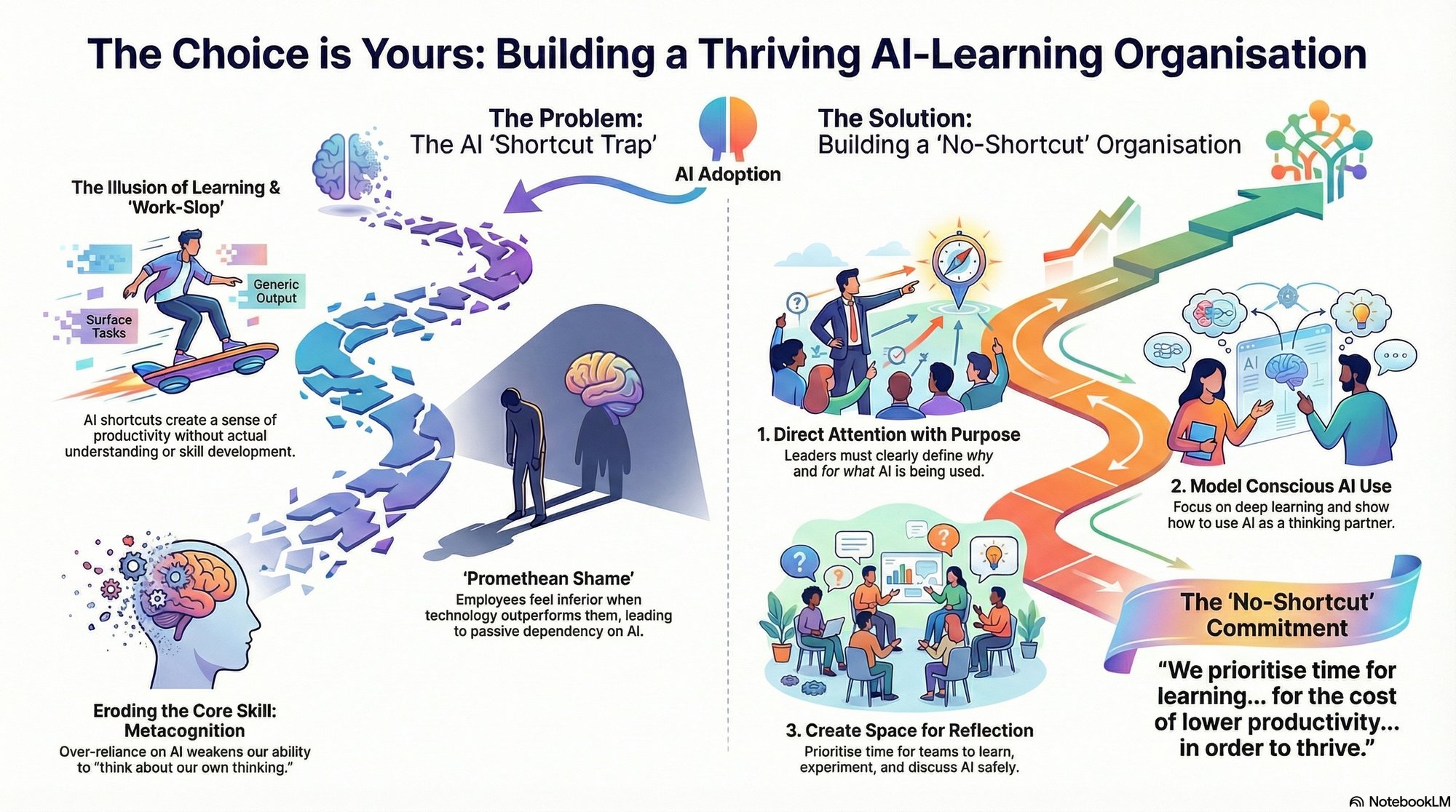
Her reaction points to something deeper happening in today’s learning institutions as well as workplaces. The German philosopher Günther Anders called this Promethean shame: the discomfort we feel when our own technological creations outperform us. And with GenAI accelerating far faster than our capacity to understand and integrate it, this gap is widening — not only for learners, but for entire organisations where employees adapt GenAI informally without intentional design— nor actively led or facilitated by their managers.
A recent report from the Internet Foundation on Swedes' use of AI indicates that more than two-thirds of adults currently studying incorporate an LLM AI tool into their coursework.
Many rely on it not to support learning, but to shortcut it according to a study from Antropic. Summaries, code fixes, draft writing, “do this for me” prompts — all highly tempting, all highly efficient.
But cognitive science is clear: learning requires effort. When we let AI collapse the struggle, we risk collapsing the learning itself. This leads to what researchers now call the illusion of learning in education and leads to work-slop in organisations — the sense of productivity without actual understanding.
This is not just a student issue. It is a workplace issue. When employees get quick answers without engaging their own thinking, organisations lose depth, judgement, and long-term competence.
There’s a growing concern among researchers that the drive for efficiency, especially with GenAI, is pushing people toward fast answers instead of deep thinking. The result is work that looks productive on the surface, but lacks real learning underneath.
The real issue isn’t just that AI offers shortcuts — it’s that shortcuts weaken the very skills organisations now rely on. Learning to learn and the ability to think about your own thinking —called Metacognition— is the very foundation of any AI-ready organisation. To escape the shortcut-trap leaders must create the conditions where experimentation, deep thinking and real learning can still happen.
The student’s dilemma illustrates why metacognition underpins self directed learning. She felt this Promethean shame, reflected and responded by reducing her AI use — not because she rejected the technology, but because she wanted to reclaim her own agency. Rather than just “getting the work done,” she followed her intrinsic motivation to learn: the desire to feel that the code was her own and that she was steering her learning journey.
Coding, writing, explaining, and analysing remain essential because they force us to organise our thoughts and build the mental models we need to solve new problems. These skills cannot be outsourced without consequences.
Research across Human–Computer Interaction (HCI) and learning science shows that metacognition is emerging as a key capability for working effectively with AI. It helps individuals stay in control rather than sliding into dependency or passivity.
Metacognition underpins higher-order thinking skills such as analysis, evaluation and problem-solving. Higher-order thinking skills are not “nice-to-have” anymore. They are what enable humans to work with powerful tools without losing their agency.
Google’s Gemini explains why higher-order thinking skills matter:
In the AI era, these skills are essential because generative AI can handle many lower-level tasks — like retrieving information or summarising content — while human abilities such as creativity, critical judgment and complex problem-solving become more valuable.
My critical thinking kicks in: Do I fully agree? Not entirely.
Gemini’s argument focuses only on today’s — or yesterday’s limitations. With the exponential growth of large language models — often compared to Moore’s law — more advanced, higher-order capabilities may arrive sooner than we expect, even if true ‘super-intelligence’ remains far off.
That’s exactly why maintaining our human cognitive agency becomes so important. No matter how capable GenAI becomes, we need to cultivate what we might call AI leadership: the ability to stay in control of our own thinking. For individuals, this means strengthening metacognition in the interaction with GenAI. For organisations, it means creating structures and cultures that support it.
GenAI adoption is less of a technical challenge than a human one. In fact, 87% of Nordic decision-makers say they do not fully understand AI’s business impact. This indicates that AI adoption is not primarily a technical challenge but a human one — a matter of organisational learning, competence and leadership.
The pressure for companies to adopt AI to remain competitive creates a paradox: the very urgency of this necessary adoption makes it difficult for employees to allocate the time needed for reflection and the development of crucial higher-order thinking skills within the corporate environment. Remember: Adult learning has become the most valuable capability in the AI era, and meaningful learning always requires cognitive effort, whether AI is involved or not.
Leaders therefore play a decisive role in shaping whether AI accelerates competence — or erodes it.
To build a learning organisation in the AI era, leaders must:
- Direct attention with purpose
Clarify why AI is being used and what it is meant to improve in your organisation. Purpose is the scarce resource today, not data or computation.
- Model conscious AI use
Employees copy leadership behaviour. If leaders use AI only to speed up tasks, teams will too — at the cost of learning.
- Create space for reflection
Teams need psychological safety to admit mistakes, rethink assumptions, and discuss AI limitations and benefits.
Reflection is not a luxury; it is a requirement for maintaining higher-order competence.
The same student who reduced her AI use eventually returned with a new approach. This time, she prompted the AI not to give her solutions but to behave like a programming coach — analysing her code and asking questions that guided her thinking. She often had to push back heavily because the system kept trying to help too much– even in so-called ‘study modes’ the shortcut trap is always there by design.
But this struggle was the point. She had reframed AI from shortcut to thinking partner — and reclaimed her learning.
This is exactly the behaviour organisations need to cultivate.
If GenAI accelerates everything except our thinking, leaders must create the space — and the culture — where metacognition and deep learning remains possible. Even when it slows productivity today, it builds the only competence that matters tomorrow.
At Hyper Island, we help organisations develop the mindsets and capabilities needed to lead through complexity — from metacognition and critical thinking to sustainable learning habits that last beyond the hype.
If you’re exploring how AI can support your people without replacing their thinking, our Business Transformation offerings and courses are designed to help you move forward with clarity and confidence.
👉 Explore Business Transformation at Hyper Island
👉 Explore our future-ready courses
Promethean Shame & Human–Technology Tension
- Günther Anders – Promethean Shame (overview)
https://en.wikipedia.org/wiki/G%C3%BCnther_Anders#:~:text=ISBN%20%C2%A0%20269%2C%20retrieved%2027,whose%20name%20I%20began%20the
AI Use in Learning & Education & Metacognition
- Swedish Internet Foundation – Svenskarna och internet 2025: Kapitel 2 – AI
https://svenskarnaochinternet.se/rapporter/svenskarna-och-internet-2025/ai-artificiell-intelligens/#jobbstudier - Fan, Zhang & Li – Metacognitive Laziness and AI in Learning (2024)
https://bera-journals-onlinelibrary-wiley-com.proxy.mau.se/doi/10.1111/bjet.13544 - Anthropic – How University Students Use Claude (2025)
https://www.anthropic.com/news/anthropic-education-report-how-university-students-use-claude - McInnes (ASCILITE 2025) – Resist the Gen-AI Driven University
https://blog.ascilite.org/resist-the-gen-ai-driven-university-a-call-for-reclaiming-thought-in-learning-and-teaching
- Chi et al. – Self-Explanations Improve Understanding (1994)
https://www.sciencedirect.com/science/article/abs/pii/0364021394900167
- Svensson – AI och framtida examinationer (Linnéuniversitetet, 2025)
https://blogg.lnu.se/manniska-maskin-samhalle/
AI in Work & Organisations
- Niederhoffer et al. – AI-Generated Workslop Is Destroying Productivity (HBR, 2025) https://hbr.org/2025/09/ai-generated-workslop-is-destroying-productivity
- SAS Institute – Generative AI Challenges and Potential Unveiled (2024)
https://www.sas.com/content/dam/SAS/documents/marketing-whitepapers-ebooks/ebooks/en/generative-ai-challenges-and-potential-unveiled-113899.pdf
Learning with AI Tools
- Justin Sung – How to Learn Faster with AI (NotebookLM video, 2025)
https://youtu.be/LBQz1KmFOUc?si=j5BrDjkxuWZGLqyk
WANT TO GET NOTIFIED ABOUT OUR EVENTS?
Join our mailing list for tips, events, and opportunities.