"At its heart, Hyper Island is a school. A place where people learn. But that's not the whole story.
Hyper Island is also a place where change and growth happen. We use experiential learning to help people, teams, and organizations develop the skills, attitudes, and confidence they need to deal with change all the time.
It's also a global group of learners, leaders, and people who are interested in learning more who grow through shared experiences. So, what makes Hyper Island different when it comes to learning?
It starts with our method of experiential learning, which means "learning by doing."
At Hyper Island, we believe that learning doesn’t happen by passively receiving information. It happens through experience. That’s why our methodology is built on experiential learning, collaboration, and reflection. Instead of long lectures and top-down teaching, we design learning environments where participants are actively involved in the process.
That means learning through:
- Doing
- Collaborating
- Testing ideas
- Making mistakes
- Reflecting
- Applying insights
- Trying again
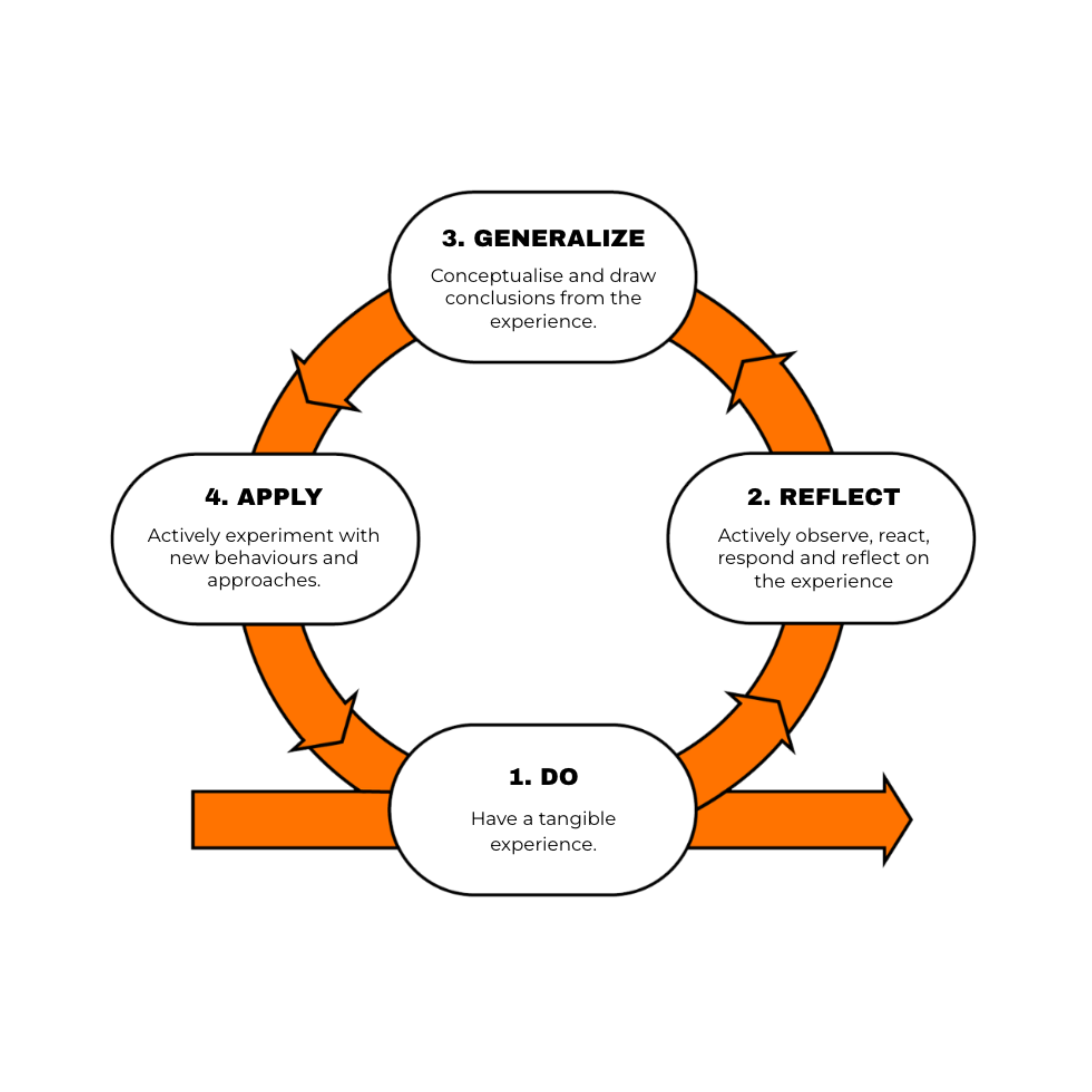
Learning is rarely a linear process. It’s messy, iterative, and rooted in tangible experiences, reflection, conceptualisation, and active experimentation. Imagine something looking a bit like this:
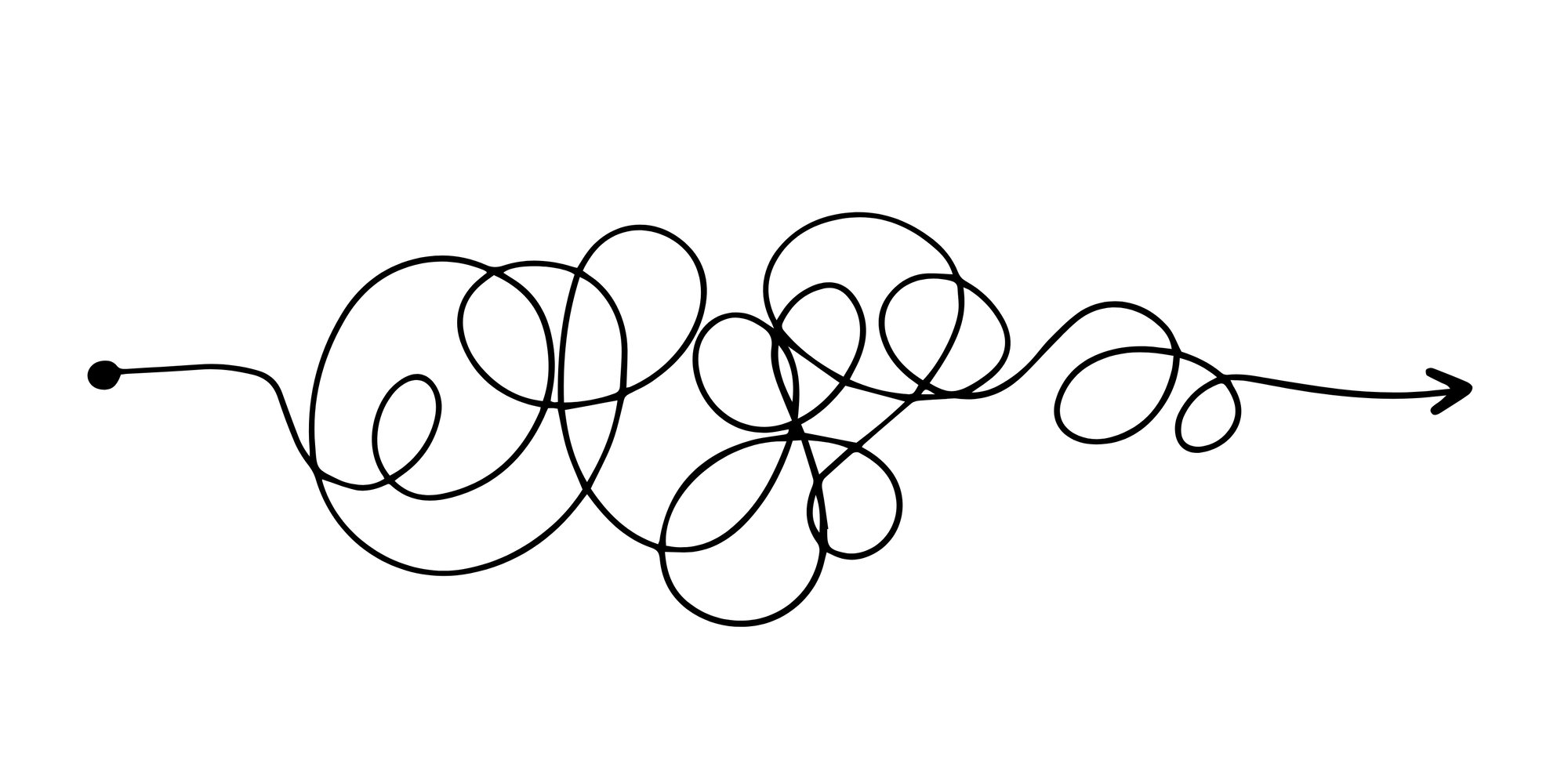
We refer to this process as the Learning Spiral, which is closely related to Kolb’s theory of experiential learning that consists of four stages: concrete learning, reflective observation, abstract conceptualization, and active experimentation.
Let’s break this process down to give you a concrete example of how learning happens at Hyper Island.
The Learning Spiral is our way of making experiential learning practical and actionable. It shows that deep learning happens when experience is combined with reflection and application.
In simple terms, the spiral looks like this:
- You Do something
Learning starts with action. Instead of reading about a problem, you’re placed inside it. This might be a real client brief, a team challenge, or a project with no clear answer. You act, decide, and engage – often without having all the information upfront. - You Reflect on it
After the experience, we slow down. What happened? What worked? What didn’t? What surprised you? Reflection turns activity into insight. Without it, experience risks becoming just repetition. - You Generalise and Draw Conclusions
Here, reflection becomes understanding. You connect your experience to concepts, frameworks, or patterns. You form new mental models by anchoring it in something you’ve lived through. - You Apply new insights
Finally, you test your new understanding. You try a different approach. You make a new decision. And that action becomes the starting point of the next loop in the spiral.
This cycle doesn’t end. It builds over time, helping learners develop confidence, adaptability, and the ability to learn from whatever situation they’re in.
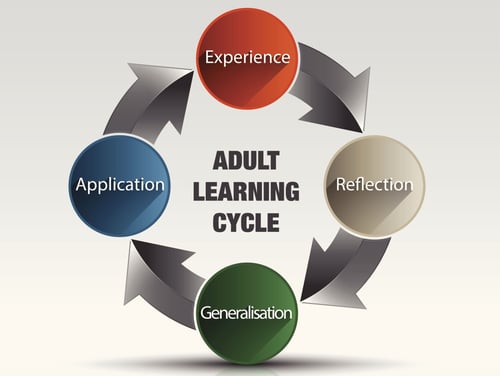
Experiential Learning Cycle. Source: Getty Images
Many of us grew up in learning environments built around lectures, exams, and right answers. This “traditional” way of learning focuses on transferring knowledge, where you have someone who knows who is trying to convey their knowledge to people who don't know.
That kind of learning can be useful for building basic understanding, but it often falls short when things get messy, complex, or unfamiliar, which is exactly how real life tends to show up.
At Hyper Island, we rather believe in experiential learning, where instead of starting with theory, we start with experience. You’re asked to step into a situation, try something, make decisions, and see what happens. Sometimes it works. Sometimes it doesn’t. Either way, you have something real to reflect on.
Research consistently shows that active participation leads to deeper learning. When learners are involved in solving real problems, motivation increases, retention improves, and the gap between theory and practice gets smaller.
Experiential learning works because:
- People remember what they do, not just what they hear
- Reflection helps turn experience into insight
- Learning becomes personally meaningful, not abstract
- Mistakes are treated as feedback, not failure
In Kolb’s words, learning is “the process whereby knowledge is created through the transformation of experience.” That idea sits at the heart of Hyper Island’s methodology.
To make the difference clearer, here’s a simple comparison:
|
Traditional learning |
Experiential learning at Hyper Island |
|---|---|
|
Linear and curriculum-driven |
Iterative and adaptive |
|
Knowledge is delivered from teacher to student |
Learners actively co-create knowledge |
|
Focus on right answers |
Focus on exploration and insight |
|
Mistakes are often avoided |
Mistakes are part of the learning process |
This doesn’t mean theory isn’t important. It is. But at Hyper Island, theory becomes most valuable after you’ve encountered a real challenge. When it helps you make sense of what you’ve experienced.
One of the most important parts of our methodology is working on challenges that reflect the realities of today’s working world.
Instead of hypothetical cases, learners at Hyper Island engage with real clients and real business challenges as part of their learning. This might mean working on a live brief from a company, collaborating with an organisation to solve a current problem, or helping shape digital solutions that matter outside the classroom.
These experiences:
- Build confidence in applying skills beyond the classroom
- Help learners understand how organisations actually work
- Create a bridge between learning and professional practice
- Prepare participants for ambiguity, not just certainty
At Hyper Island, working with real clients is an essential part of how experiential learning becomes reality. It’s not about simulating work. It is work. And this is supported by reflection, facilitation, and a strong learning framework.
At its core, Hyper Island is a place for learning. But as you’ve seen, it’s also a place where people learn how to learn, through experience, reflection, collaboration, and real-world application.
We believe in this learning methodology because the world is unpredictable. Roles evolve. Tools change. Industries transform.
What remains valuable is the ability to adapt. To learn continuously. To collaborate with others. To reflect on lived experiences, and move forward with more confidence.
Experiential learning doesn’t just teach specific skills. It helps people develop meta-learning, the ability to learn from any experience, in any context. And that, more than anything, is what prepares individuals to lead, create, and adapt long after their time at Hyper Island.
If you’re looking for learning that goes beyond theory and prepares you for real work, real challenges, and real impact, Hyper Island’s educational offerings provide a hands-on path forward.
👉 Explore our part-time Master's program


WANT TO GET NOTIFIED ABOUT OUR EVENTS?
Join our mailing list for tips, events, and opportunities.

%20New.png)